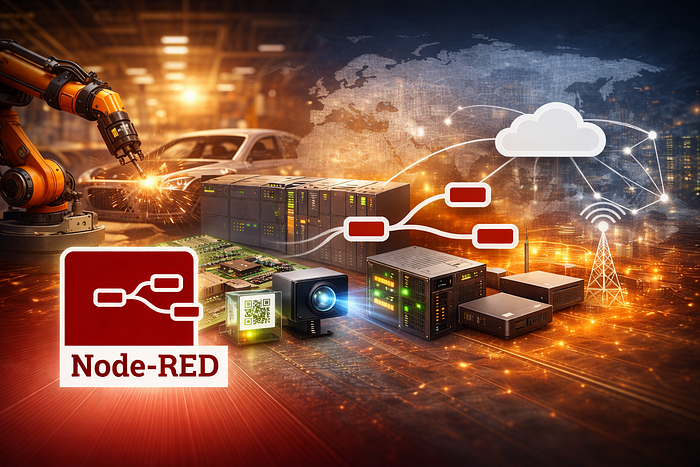

Topics: Node-RED, Industrial Automation, PLC Integration, Industry 4.0, Siemens S7
Introduction
Is Node-RED production ready for industrial automation systems, or is it best suited for prototypes and proof-of-concept projects? Even now, this question occasionally arises in discussions about Industry 4.0 architectures, industrial IoT platforms, and digital transformation in manufacturing.
Node-RED is a flow-based programming tool designed to connect devices, APIs, and services, and it is increasingly used in industrial automation environments.
In this conversation, Walker Reynolds, Klaus Landsdorf, and Oriol Rius discuss real-world experiences deploying Node-RED in production environments. The discussion explores how Node-RED can be used in industrial automation systems, including integration with Siemens S7 PLCs, factory production lines, device communication protocols, and data collection pipelines.
Klaus and Oriol share with Walker some practical examples of how Node-RED is used as an integration layer between operational technology (OT) and IT systems, connecting factory equipment, sensors, databases, and enterprise platforms. They also discuss the long-standing debate about whether Node-RED is suitable for long-term industrial deployments, and how improvements to the platform — including version 3 compatibility and ecosystem tooling such as FlowForge (now FlowFuse) — have helped organizations run Node-RED at scale.
One example described in the discussion involves a Mercedes-Benz production line, where Node-RED was deployed as part of the system controlling and monitoring a key printed circuit board (PCB) manufacturing process. The conversation highlights how Node-RED can simplify device integration, reduce software complexity, and make long-term system maintenance easier compared with traditional custom code solutions.
Node-RED in Industrial Automation Architectures
Node-RED is increasingly used as a lightweight integration layer within industrial automation systems, particularly where operational technology (OT) systems must communicate with IT infrastructure. In these environments, Node-RED often acts as a bridge between PLC controllers, industrial protocols, databases, and cloud services.
A common use case involves connecting Siemens S7 PLCs, sensors, and production equipment to data pipelines that support monitoring, analytics, and traceability systems. Node-RED's flow-based programming model allows engineers to build integrations quickly while keeping the resulting logic easy to maintain.
Since Node-RED can run on embedded PCs, industrial edge devices, and servers, it is frequently deployed close to manufacturing equipment where it can collect and transform data before forwarding it to enterprise systems. This makes Node-RED particularly useful in Industry 4.0 architectures, where factories must integrate legacy machines, industrial networks, and modern data platforms.
The discussion below explores real-world examples of these architectures in production environments.
What This Discussion Covers
Key topics discussed in this Node-RED production deployment conversation:
- Node-RED in Industry 4.0 architectures
- Using Node-RED with PLC systems such as Siemens S7
- Why maintenance and simplicity are critical in industrial software
- The role of FlowForge (now FlowFuse) in managing Node-RED deployments
- Whether Node-RED is suitable for production-level industrial solutions
Full Conversation
Transcript
Node-RED in Production Environments
Walker: Let's start there. Node-RED in production. Because I think this is a question most people have. Where does Node-RED fit in Industry 4 architectures? Where does it fit as part of a much larger digital transformation initiative? Klaus, in your perspective, Oriol, in your perspective, you obviously believe Node-RED is production ready. That is, it is robust enough to be a link in a very important technical supply chain within an organization. Tell me why.
Oriol: Just let me answer with a fast question, okay Walker? If in two years, after saying deploy, you don't go back to that factory and you don't have to do anything, you can say it is production ready. In two years, just two years.
Walker: Yeah.
Oriol: it's good enough?
Walker: Yeah, absolutely.
Example: Node-RED in a Mercedes-Benz Production Line
Oriol: Yep. Okay, this is the last success that they have with Node-RED. Last, not the first, you know. And this is a production line for Mercedes-Benz, for the PCB that controls the complete car. It's the keyway line for that PCB, so it's not a minor thing. In two years I didn't receive a call until last week. What happened? They need a new database connection for tracing much more data.
Walker: And what are you using Node-RED for there? Is it data ops? Is it data ingestion transformation?
Oriol: Yeah.
Walker: Is that what you're doing? Is that it primarily?
Oriol: In that concrete case, okay? Not generalization. In that concrete case we have a line completely controlled by S7 from Siemens, okay? So all the automations and the controls people, it's that PLC, okay? And then, as you already said, Walker, shhh … don't say this is open source, just say this is an embedded PC, right? We need an embedded PC for completing the project with the requirements that you launched. What were the requirements? Easy. SQL injection of the tracing data of all the tests that we do. Controlling 3D vision cameras. Controlling QR code recorder with a laser. And also an ink printer. And no one knows how to control that if they don't install Windows with a lot of drivers, with a lot of licenses, with a Visual Basic code for controlling all that stuff. And they said — 'can you do that for next Monday?' It was Friday. Yeah, of course, yes I can. 'But we don't have the drivers for Linux and all that stuff.' It's just a regular ink printer. It's just a regular serial protocol. I mean, in just a weekend, with maybe 12 hours working during the weekend, it was enough for complementing the complete control of that S7 PLC with that stuff that was impossible to do if they didn't install Windows with Visual Basic stuff, with a lot of proprietary stuff that no one knows how to maintain.
Node-RED Maintenance and Long-Term Support
And for me this is the key, the word 'maintenance'. I don't know Klaus if you agree with that, but what I really love about Node-RED is after two years if I go back to the flow, in less than a minute I know what I have to touch, what I have to modify. I mean the maintenance is intuitive. If you have code there, maybe you have 12 lines, maybe you have 5 lines, maybe 20 lines, but you don't have 200 lines because if you do that you are not using Node-RED, okay? You are doing something wrong. What I mean is for me the value of Node-RED is the maintenance. Then in general, and just to be short because Klaus has to give his version, sorry Klaus, from my perspective what is easy to insert Node-RED in production ready projects is where there is no other thing or no other cheap thing that can do all that you have to do for that project. For instance, multiple device control, proprietary devices. I mean you have the specification of the protocol but there is no driver of that protocol because everything is proprietary, everything is locked. And then to have that platform that you can control to the last bit is your flexibility, your dynamism, your creativity can explode. Now it can be boosting the project in a short period of time. But if I have the chance to choose not to fix, and this is another thing — to choose — in my perspective Node-RED can be the integration part that connects the fieldbus protocols with IT.
Walker: Is that the predominant use case for you, Oriol? It's the shim?
Oriol: Let me say 30 or 40 percent of the cases, okay?
Walker: Okay. Got it. Alright.
Oriol: Not 100%.
Walker: Klaus. Production ready. Obviously your position is going to be yes, Node-RED is robust enough for production level solutions. But your argument in that case, because by the way this is a common objection you'll hear. The common objection will be yeah Node-RED is great for POC, it's great for wireframing, it's great for one-off use cases. Maybe I'm going to deploy an edge device, I'm going to acquire some data, and then I'm going to remove that edge device. It's not going to stay there forever. But the argument predominantly is can I, should I really be using it in production? So Klaus, your take there.
When Node-RED Became Production Ready
Klaus: Yeah, perfect. That's really my point also. I got this question over the last eight years a lot. So often people ask me, hey can we go with production? And I said until version three, no, completely no. That was my perspective. Every time I said it's just my perspective. If you try it, I know a lot of people like Laurent state that they are really successful. We saw some projects like Open Wallbox which used our Modbus package to control your electric car, charging really well with this because it takes just a bit of data to collect them, to organize them, and that's it. But if I think on production, I also have some more long-term support in mind. And that means we need to be backward compatible. We need some migration of existing flows, etcetera. And that was not existing until version three for me. Because if I took my very early flows from version one and put it to two, everything was broken from it because it was a string or number, it was whatever. So this was one step where I also worked with this. I really can say the team, the core team of Node-RED, was really great to go with that problem and to say hey we solved that really fast. That's great also. We discussed that the community also have to discuss with the core team: 'does it make sense or doesn't it?' And it makes a more high quality process over time than you have in every other software for me. Because where do you have the ability to talk with a lot of people with real use cases if that makes sense or not? And with version three we also saw that it's backward compatible. Boom. That was the last point that we missed. And now from version three I really can say from my perspective it's absolutely production ready. FlowForge (now FlowFuse) also brings the last step that we missed with organizing Node-RED. I think we will also talk about this later. But this was for me also a point which really was pain. And I think also for a lot of people that use that in mass deployments or something like this, they have to find a way how to bring the flows on it, the settings, security credentials, whatever.
Walker: Yeah, I mean here's the real question that came up, which was if Node-RED, I mean this is a logical point, if Node-RED is not production ready then what's the purpose of FlowForge? Right? Like if you're not going to use Node-RED at scale, so you're going to deploy it at scale across an organization in production solutions, then what's the point of FlowForge? This was totally the question that I asked myself and it was sort of this light bulb moment before I did that post. Because I'll be honest with you, my opinion of Node-RED has changed since I went down the rabbit hole researching how FlowForge has evolved over the last 12 months. And my position today is that Node-RED is, in fact, production ready.
If you're using Node-RED in industrial systems, I'd be interested to hear how you're deploying it.