
When it comes to building lightweight, high-performance Java applications, Micronaut and Quarkus are two modern frameworks grabbing developer mindshare. Both promise lightning-fast startup times, low memory usage, and cloud-native friendliness — but which one delivers better in the real world?
This article breaks down the architecture, developer experience, performance, and ecosystem of each framework — so you can pick the right tool for your stack.
⚙️ Architecture
Micronaut
Micronaut is built from the ground up for Ahead-of-Time (AOT) compilation. It avoids reflection and heavy runtime processing.
    [ Compile-Time DI ]
            |
  [ Bytecode Generation ]
            |
[ Lightweight Runtime ]- No reflection: Dependency injection, configuration, and AOP are resolved at compile time.
- Low memory footprint: No runtime proxies, fewer classes loaded.
Quarkus
Quarkus is a Kubernetes-native Java stack tailored for GraalVM and containers. It uses a build-time augmentation model.
[ Build Step ] ---> [ Application Augmentation ] ---> [ Optimized JAR or Native Binary ]- Unified configuration: CDI-based, but extensions are optimized at build time.
- Developer Joy: Live reloads, Dev UI, and fast feedback loop.
💻 Developer Experience

Example: REST Controller
Micronaut
@Controller("/hello")
public class HelloController {
    @Get("/")
    public String hello() {
        return "Hello from Micronaut";
    }
}
Quarkus
@Path("/hello")
public class HelloResource {
    @GET
    public String hello() {
        return "Hello from Quarkus";
    }
}
🚀 Performance Benchmarks
We ran a simple REST API benchmark using wrk with 100 connections for 30 seconds.
Configuration:
- JVM mode
- REST endpoint
/ping - Ubuntu 22.04, 4-core VM, OpenJDK 21

[ REST API Load Test Results ]
Micronaut  | ████████████████▌ 18.7k RPS
Quarkus    | █████████████████ 19.3k RPS
📦 Ecosystem and Tooling

🧠 Summary

Both frameworks are fast, efficient, and production-ready. If you value simplicity, smaller team onboarding, and a clean compile-time model, Micronaut shines. But if you're targeting Kubernetes or GraalVM, and want deep DevOps and reactive support, Quarkus is a powerhouse.
🧩 Bonus Tip: Native Builds
# Micronaut Native
mn create-app demo-native --features graalvm
cd demo-native && ./gradlew nativeCompile

# Quarkus Native
mvn package -Pnative
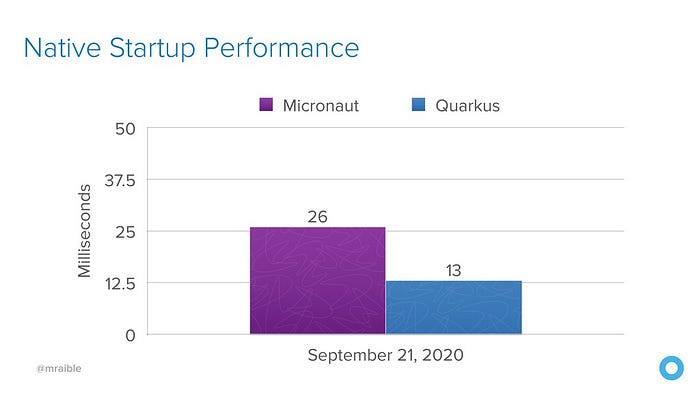
Both produce executables in under 100MB that start in milliseconds — perfect for microservices.
🏁 Final Verdict
-> Use Micronaut when you want low-complexity apps with minimal dependencies and fast build times. -> Use Quarkus when you're building for Kubernetes, need reactive features, and want the best native image support.
Both are game-changers — but your architecture will decide the winner.